
- Cyber Success
- September 21, 2026
- IT Courses
SQL or MongoDB? A Data Scientist’s Guide to Choosing the Right Database
“SQL vs NoSQL” has been debated in tech circles for over fifteen years, ever since MongoDB launched in 2009 and gave developers a genuine alternative to the relational databases that had dominated since the 1970s. For a data scientist specifically, though, this isn’t really an either-or decision to settle once — it’s a practical judgment call that depends entirely on the shape of the data you’re actually working with on a given project.
The Core Distinction: Structure vs Flexibility
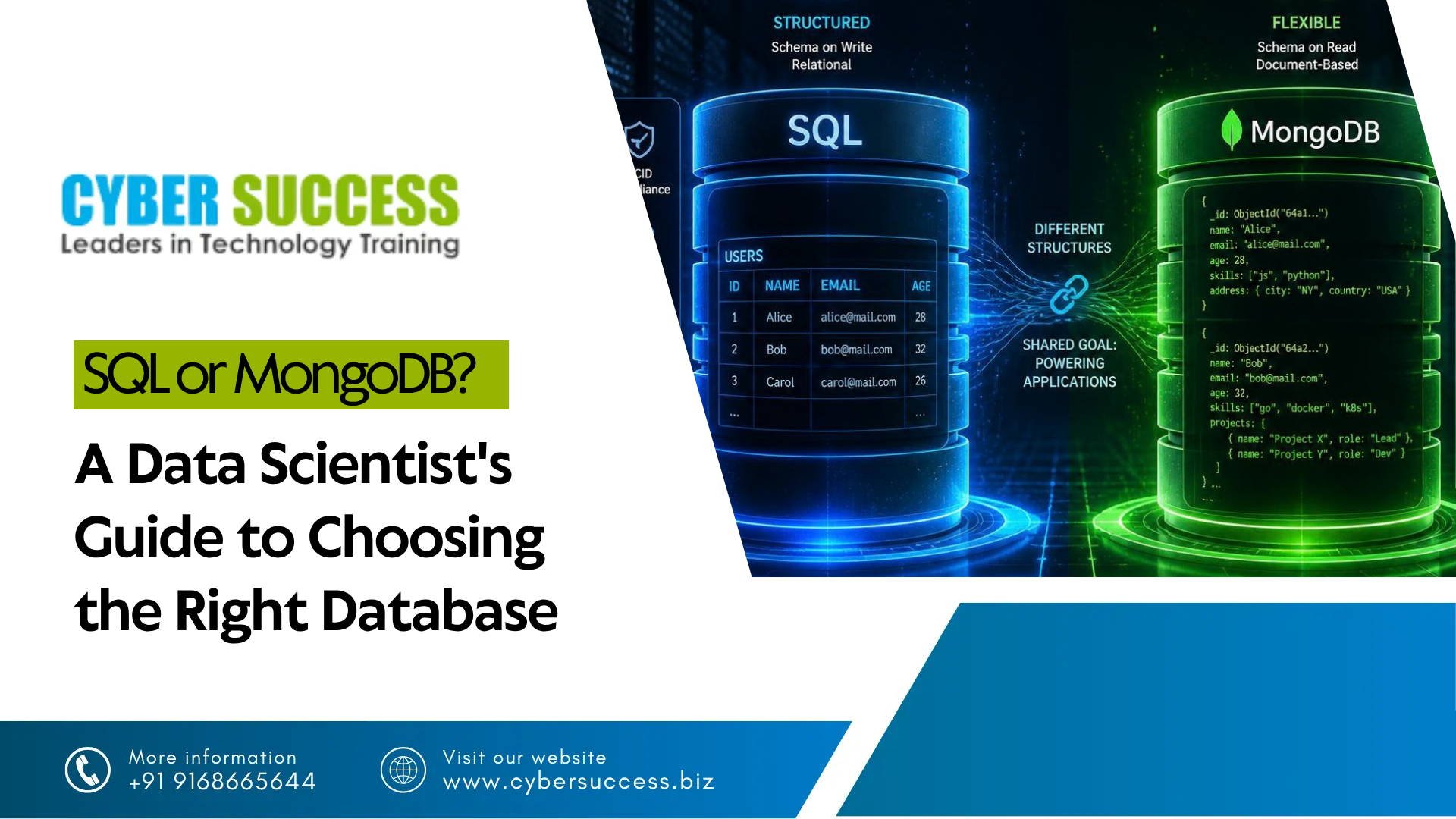
SQL databases (relational databases like PostgreSQL and MySQL) store data in structured tables with predefined schemas, where every row follows a consistent, fixed format and tables connect to each other through relationships using foreign keys. MongoDB, a NoSQL document database, stores data as flexible, JSON-like documents with no predefined schema required, making it well-suited to data that’s naturally nested, varied in structure, or evolving over time. The single question that resolves most of this decision quickly: is your data highly relational and consistently structured, or is it flexible, nested, and likely to change shape as your project evolves?
When SQL Is the Right Choice for a Data Scientist
SQL remains the default choice for most structured, tabular analytical work — and for good reason. SQL databases offer strong support for complex queries and joins, mature analytics tooling, and ACID transaction guarantees that ensure data consistency, which matters enormously when working with financial records, customer transaction histories, or any dataset where accuracy and relational integrity are non-negotiable. PostgreSQL specifically has become the more versatile choice for most projects in 2026, since it handles both relational and semi-structured data well — it supports JSON natively, giving it meaningful document-store flexibility while still providing SQL’s mature query and join capabilities.
SQL is generally the right choice when:
- Your data is highly relational, with clear connections between entities (customers, orders, products)
- You need complex queries involving multiple joins across several tables
- Data consistency and transactional integrity are critical (financial records, inventory systems)
- Your schema is stable and well-understood in advance
- You’re doing traditional statistical analysis or building models on structured, tabular data — which describes the large majority of standard data science work
When MongoDB Is the Right Choice for a Data Scientist
MongoDB is better suited for rapid prototyping with changing schemas, document-centric data models, and applications that need horizontal scaling out of the box — situations where SQL’s rigid, predefined schema becomes a genuine obstacle rather than a helpful constraint. For a data scientist specifically, MongoDB becomes the more natural choice when working with genuinely unstructured or semi-structured data: nested JSON from an API, social media data with wildly varying fields per record, sensor or IoT data with an evolving structure, or any dataset where different records legitimately have different fields and that variability is expected rather than an error to be normalized away.
MongoDB is generally the right choice when:
- Your data is naturally nested or document-shaped (user profiles with varying attributes, product catalogs with inconsistent fields)
- The schema is expected to evolve frequently as a project or product develops
- You need to scale horizontally across many servers to handle very large data volumes
- You’re working with semi-structured or unstructured sources — JSON API responses, log files, content with varying formats
- Rapid prototyping matters more than enforcing a strict, predefined structure early in a project
A Practical Decision Framework
Question | If Yes → | If No → |
Is your data highly relational (clear entity relationships)? | SQL | Consider NoSQL |
Do you need strict ACID transaction guarantees? | SQL | MongoDB may be acceptable |
Is your data naturally nested/document-shaped and varies in structure? | MongoDB | SQL likely fits better |
Do you need complex, multi-table joins for your analysis? | SQL | MongoDB’s limited join support may not matter |
Is your schema likely to change frequently during the project? | MongoDB | SQL’s structure is an asset, not a limitation |
Do you need to scale horizontally across many servers from day one? | MongoDB | SQL scales well enough for most single-server analytical workloads |
What the 2026 Usage Data Actually Shows
Real-world adoption data offers a useful reality check against the “NoSQL is the future” narrative that was common a decade ago: PostgreSQL is used by roughly 48.7% of developers surveyed, compared to MongoDB’s 25.3% — a meaningful gap that reflects how much analytical and general-purpose work still genuinely favors relational databases. This doesn’t mean MongoDB lacks a real, valuable place; MongoDB 8.0 delivers notably higher read throughput and substantially faster time-series aggregations in its specific strong-fit scenarios, and its continued strong revenue growth reflects real, sustained enterprise adoption in the document-database niche it’s built for.
A Key Limitation Worth Understanding: MongoDB and Joins
MySQL and other relational databases support relational joins via foreign keys as a core, well-optimized feature, while MongoDB does not natively support joins in the same way — this is a genuinely significant limitation for data science work that frequently needs to combine data across multiple related entities. While MongoDB’s aggregation framework offers a $lookup stage that can approximate join-like behavior, it’s generally less performant and less intuitive than SQL’s native join support for genuinely relational, multi-table analytical queries — worth factoring in heavily if your analytical work regularly requires combining several related datasets.
Beyond SQL vs MongoDB: Other Database Families Worth Knowing
“NoSQL” itself hides enormous variety, and MongoDB is just one specific family within it — data scientists should know the broader landscape exists, even if SQL and MongoDB cover most day-to-day needs:
- Key-value stores (Redis) — blazing-fast lookups by key, ideal for caching, session storage, and rate limiting, but not suited for complex analytical queries
- Wide-column stores (Cassandra, Bigtable) — built for massive write throughput and predictable queries at genuinely large scale, prioritizing volume over relational joins
- Graph databases (Neo4j) — the right choice when the connections between data points are themselves what you’re analyzing — social networks, fraud detection rings, recommendation systems
- Time-series databases (InfluxDB, TimescaleDB) — optimized specifically for timestamped data written in order and queried by time range, common in IoT and monitoring-heavy data science work
Can You Use Both? Yes — Polyglot Persistence
Many modern data architectures don’t force a single database choice across an entire project — this practice, called polyglot persistence, uses SQL for transactional, structured data (orders, users, payments) while using MongoDB or another NoSQL database for a specific component that genuinely benefits from flexible, document-based storage (user activity logs, product catalogs with varying attributes). For a data scientist working within a larger engineering team, understanding that this hybrid approach is common and legitimate — rather than assuming a project must commit entirely to one database family — reflects a more accurate picture of how real production systems are actually built in 2026.
Final Word
The “SQL vs MongoDB” question isn’t really about which database is objectively better — it’s about matching the database to the actual shape and behavior of your data. SQL remains the right default for structured, relational data science work requiring complex joins and transactional integrity, while MongoDB earns its place specifically for nested, flexible, or rapidly evolving data. For most data scientists, SQL fluency matters more and should be prioritized first, with MongoDB knowledge added as a valuable secondary skill once genuinely document-shaped data enters the picture.
Cyber Success’s Data Science course in Pune builds strong SQL fundamentals as a core skill, with exposure to how modern data architectures use both relational and NoSQL databases in real-world projects, backed by placement support to help you apply this skill set confidently. Explore our Data Science course to build the database skills real analytical work actually demands.
Frequently Asked Questions
Should a data scientist learn MongoDB, or is SQL enough?
SQL remains the more essential, broadly applicable skill for the large majority of data science work, since most structured, tabular analytical tasks and traditional statistical modeling rely on relational data — but learning MongoDB’s basics is genuinely useful for projects involving nested, semi-structured data like API responses or log files, which do come up regularly in real-world data work.
Why doesn’t MongoDB support joins the way SQL databases do?
ongoDB’s document-based model is built around storing related data together within a single, nested document rather than splitting it across separate, linked tables, which is why it doesn’t natively support relational joins the way SQL databases do — its aggregation framework offers a $lookup stage as a partial substitute, but it’s generally less performant for genuinely complex, multi-entity analytical queries.
Is MongoDB better than SQL for handling very large datasets?
Not universally — MongoDB’s strength is horizontal scaling for document-shaped or rapidly evolving data, while SQL databases like PostgreSQL handle very large structured, relational datasets extremely well too, particularly with proper indexing; the right choice depends more on your data’s actual shape and query patterns than on dataset size alone.
What is polyglot persistence, and does it matter for data science work?
Polyglot persistence is the practice of using different databases for different parts of the same system — SQL for structured, transactional data and MongoDB for flexible, document-based components, for example — and it matters for data scientists because real production data often lives across multiple database types, meaning genuine data science work frequently involves pulling from more than one source rather than a single, uniform database.
Which database should I learn first if I’m starting a career in data science?
SQL should be learned first and prioritized — it’s the more universally required skill across data analyst and data scientist job postings, forms the foundation for understanding relational data concepts that transfer to other databases, and covers the large majority of structured, tabular data science work you’ll encounter early in a career.